
Temple of St. Archangel Gabriel
Location: Koželj
Year of construction: 1935/36. (on the foundations of an older sacral medieval object from the 13th century and church from 1892)
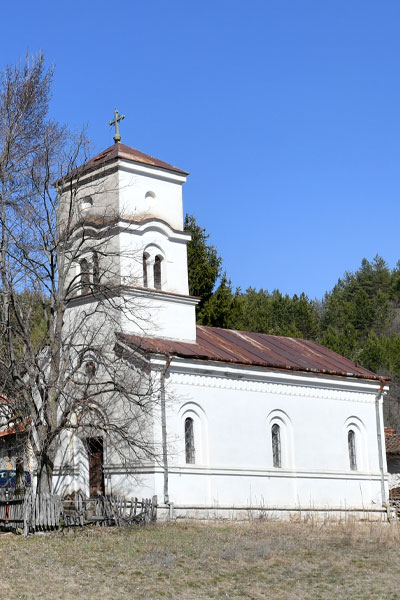
The Church of St. Archangel Gabriel is located in the centre of the village, opposite the cooperative home.
The gate of the church is in the form of a smaller courtyard in the width of the temple itself, surrounded by a wooden fence. In the gate of the church, in addition to the stone remains of the oldest sacred building, the base, parts of the capital and fragments of the lintel, there are also two monuments to those who died in the First and Second World Wars.
The newer church was built in 1892 on the foundations of an older sacred building from the 13th century.
It is built of stone, in the form of a long, massive building with side choirs modelled after triconchal churches of Moravian architecture.
The time and method of construction of the church were evidenced by the inscription that was located next to the entrance on the south side:
“In the name of the Father and the Son and the Holy Spirit, this Holy Temple was built in the village of Koželj in honour and glory of the holy Archangel Gabriel during the reign of His Majesty our Serbian King Alexander I Obrenović V with the blessing of His Highness Bishop Melentije of Timok, and with the help and sacrifice of the citizens of the parish of the village of Koželj, and with the greatest contribution of the president of the municipal court Mr. Dina Milijić. Given to the village of Koželj in the year of 1892 on the 13th of June.”
On the left side it is written:
“Municipal President Dina Milijić, contributors Veljko Stojanović, with other citizens”
and on the right side:
“the calm priest I.P. Golubović, tutors: Dina Milijić and Stanoje Ranđelović.”
This stone slab is preserved today in fragments in the churchyard, but the text can still be read. Already at the beginning of the 30s of the 20th century, the church was in a bad state. At that time, preparations for the construction of a new church began.
A memorial plaque in marble testifies the construction of the present church in the village of Koželj. The following inscription is written on it in black letters:
“In the Name of the Father and the Son and Holy Spirit, this temple is being built in honour and glory of the Council of St. Arch. Gabriel during the reign of his majesty King Peter II and the Blessing of the Bishop of Timok reverend PhD Emilijan, and with the help of the citizens of the Village of Koželj, the Cooperative Brothers and the benefactor Svet. Ranđelović, innkeeper. And under the leadership of the director’s committee in 1934-1936. Mr. President. Dir. Board Borislav Milošević, Secretary Vlada Milenkovic Members: priest Dobrosav Milićević, Milo…”.
Next to this inscription there is another plaque with an inscription written in golden letters:
“Benefactors of the Church of Koželj in 1938.” 1. Bogdan Paunković, pensioner from Negotin and 2. Dragoljub Paunković. The municipality of Koželj president, the brothers donated a lightning rod 3. Svetolik Ranđelović innkeeper from Zajecar and their son-in-law presented a cross.”
The church was built in 1934/36 and it was restored in 2002 thanks to the efforts of Ignjatije Živković. Then the roof structure and broken windows were replaced on the church.
Gallery


Architecture
The church was built in 1934/36, on the site of older sacral buildings, has the base of a long single-nave building with a semicircular apse on the east, somewhat narrower than the nave of the church, and a belfry on the west side above the entrance.
It was built of solid material with a combination of stone and brick, plastered and painted white. It is covered with a two-pitched tin roof. The outside of the church is very simply decorated. The building rests on a stone plinth. The walls are divided horizontally into two parts by a double outlet. Beneath the roof is a series of double-blind arches.
The entrance to the church is highlighted by double semicircular vaulted blind niches, at the top of which is a lunette with a fresco of the Council of St. Archangel Gabriel, which is hardly recognizable today. The circular window opening is located above the entrance to the church, surrounded by double-stepped circular fields. On the western facade, above the entrance to the church, there is a massive belfry placed on a square base. The middle zone of the bell tower is decorated with double windows – biforas. There are three windows each on the north and south walls, while there is only one on the apse.
The interior of the church is simple and without any traces of decorative painting or fresco painting. The solea, with the altar area, is raised by one step compared to the rest of the temple. To the north of the entrance, stairs lead to the gallery, i.e. into the bell tower. Next to the northern wall of the nave of the church is the bishop’s throne.


Based on the inscription on the beam on the inside of the iconostasis, we learn that the present iconostasis was made in 1936.
The inscription reads: “Made VI -1936.” Ivan J. Melnikov, fresco painter from Bitola.”
The wooden iconostasis is painted white. It is divided horizontally into four zones. The lowest zone has parapets with square fields bordered with gilded wood applications.
There are stars in the parapet fields at the north and south ends of the iconostasis, while in the fields next to the imperial doors are carved Greek crosses. The first zone also includes the royal doors with the representation of the Annunciation, as well as the representation of the Assembly of the Holy Archangel Gabriel, on the northern doors, then enthroned icons of the Virgin with Christ and Jesus Christ, while on the southern doors is Saint John the Baptist. In the second zone, north of the Last Supper centrally placed, there are representations of the Assumption of the Virgin, the Presentation of the Virgin, the Birth of the Blessed Virgin, and to the south are the Nativity of Christ, the Baptism of Christ and the Descent into Hell. The highest, Deesis row consists of fifteen icons representing the act of Deesis, where the Virgin and Saint John, from the north and south sides, accompanied by six Apostles each, turn to Christ, whose icon has a central position.
Above the Deesis order, there is a blue, spherical field decorated with golden six-pointed stars, on which is the Crucifixion of Christ, next to which are standing representations of the Virgin and Saint John the Theologian in medallions. Next to them are the symbols of the Sun and the Moon, the Gospel and the Tablet of the Law.