Church of St. Elijah
Location: Crni Vrh
Year of construction: 1927
There is different information about the construction of the Church of the Holy Prophet Elijah in Crni Vrh.
According to some sources, it was built in 1932, that is, from 1925 to 1927.
In the chronicle of the village, there is also a record of a certain priest Nikola who initiated the collection of donations for the construction of the church, so that the building would be completed in the 30s of the 20th century.
According to the locals, the church was consecrated by Bishop Dositej of Nis in the 30s of the 20th century, when a big celebration was held in the village on that occasion.

The church was built on a raised plateau on the left bank of the Crnovrška River, below the road leading to Stara Planina. Next to the church, on the northwest side, there is a belfry, made of light wooden construction on a square stone base, covered with a four-pitched roof.
On the south side of the church, there is a covenant cross made of stone reinforced with a metal weight in the shape of a cross, and on this side, a little further from the church, there is also a wooden porch covered with tiles. In front of the church, to the left and right of the entrance, there are metal candle burners.
Gallery


Architecture
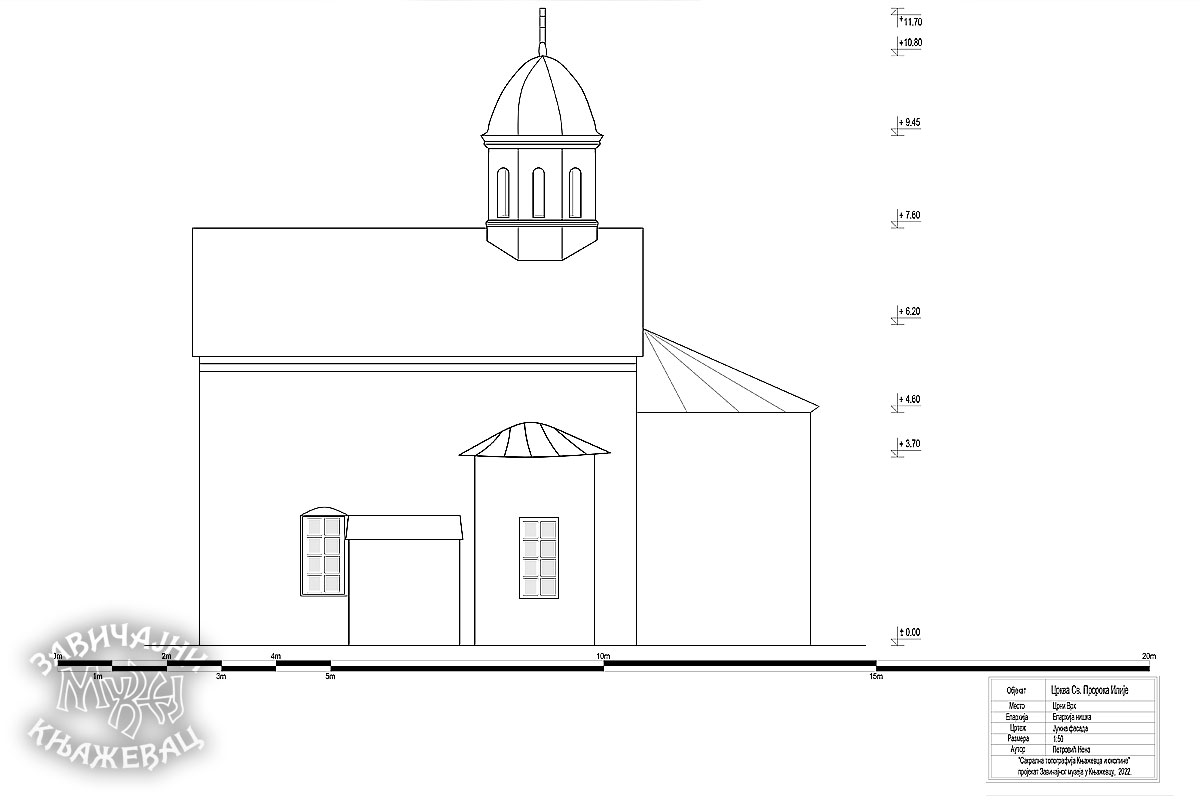
The Church of St. Prophet Elijah in Crni Vrh was designed as a single-nave, tri-dome building, vaulted with a semi-circular dome, while the gable roof of the church is covered with tiles. It was built of stone, plastered, and then whitewashed. It is divided into three parts: the altar area, the under-dome area and the nave. In the east, there is a spacious, semi-circular apse on the outside and inside, covered with a tin roof. At the cross section of the trave, above the solea area, rises a dome resting on a narrow, tall, externally octagonal tholobate.
The dome is octagonal on the outside and inside, covered with a tin roof. On the north and south sides of the church, there are smaller side domes, outside and inside semicircular covered with a tin roof. The facade cloth of the church is without additional decorations. There is one simple window opening on the south and north walls of the nave of the church, as well as on the altar apse and side chanters’ desks. On the western facade of the church, above the entrance door, there is a small niche for the icon of the patron saint of the temple, and above it, there is a small circular opening. There is also a side door on the north side.


The altar partition is most likely the work of an icon painter and it was created at the beginning of the 20th century. It is painted in light blue. It is a higher altar partition that is divided horizontally into three zones, while the impression of verticality is achieved by the arrangement of four icons of standing figures of saints in the throne zone.
In the lowest zone, which is not physically or visually separated from the upper zone, tall and slender vases with flowers are displayed. The lower zone includes the icons of St. Archdeacon Stephen, throne icons of the Holy Mother of God and Jesus Christ and St. Archangel Michael, as well as the performance of the Annunciation at the royal doors.
The upper zone includes two rows of icons with individual icons of St. Apostles. In the lower row there are three icons of St. Apostles, placed to the left and right of the central representation of the Last Supper, namely St. Evangelist and Apostle John, St. Apostles Peter and Paul, and St. Apostles Andrew, Bartholomew and St. Apostle and Evangelist Mark. In the upper row there are six icons from performances of St. Apostles, on whose left and right sides there are representations of lions. They are the icons of St. Apostle and Evangelist Luke, St. Jacob and St. Thomas and St. Apostle and Evangelist Matthew, St. Philip and St. the apostle Judas who is designated as an evangelist. The altar partition ends with a smaller Crucifix, under which are representations of the sun and the moon, while under Christ’s feet, in medallions, are the Mother of God and St. John the Theologian.
The decoration of the iconostasis is made in gold and purple on a blue background. Above the icons of the side doors are shown two six-pointed golden stars from which rays shine towards the icons. Centrally above the icons are gold Greek crosses. Above the throne icons are chalices painted in golden color with crossed symbols of suffering (crossed spears). Stylized crosses are in the corners of the iconostasis. In the lower zone of the royal doors, there are scenes of the Annunciation in rectangular frames, while above them, on each side, there is a six-pointed star made in relief as an application made of wood and painted in golden color. At the top of the royal door is a simple cross. All the icons, as well as the iconostasis itself, were made using the tempera technique on wood, except for the throne icons, the Last Supper and the representations on the royal doors, which were made using the oil on canvas technique.


The fresco painting is the work of hieromonk Naum Andrić, the most active student of the icon painting school in Rakovica monastery. According to him, he did the first tempera wall paintings in the church in Crni Vrh on the Bulgarian border. The painting is horizontally divided into two zones by ocher strips. The vertical division is also carried out by these ocher strips. In the semi-dome of the altar apse is the Virgin of the Signs, which dominates this space and is not obscured by the altar partition.
Below it, in the area north and south of the window of the altar apse, are representations of St. Basil the Great and St. John Chrysostom. In the niche of the proscomidia there is a performance of Prayer on the Mount of Olives. Above the southern chanter’s desk is the representation of St. Prophet Elijah. On the southern pilaster are representations of St. Alypius the Stylite in higher, and St. Martyr Boris, in the lower zone.
On the southern wall of the nave in the upper zone are representations of St. Joasaph of Belgorod, St. Nicholas the Wonderworker, St. Sava the Archbishop of Serbia, St. Simeon the Myrrh-Streaming and St. Simon. In the lower zone, on the walls to the side of the window, there are depictions of St. Evangelists Luke and St. Mary of Egypt. On the western wall of the nave, in the upper zone, representations of St. Martyr Heron, St. Dimitri Rostov, St. Apostle Simon the Canaaean, St. Great Martyr Pantaleon and St. Martyr Barbara.
In the lower zone, south and north of the entrance door, there are representations of St. Archangel Gavrilai St. Archangel Michael. On the north wall, in the upper zone, there are standing representations of saints, namely unknown saints (the inscription is illegible), St. Martyrs Julia, St. Nino of Georgia, St. Sergius of Radonezh and St. Seraphim of Sarov. In the lower zone of the seventh wall of the nave of the church are representations of St. Great Martyr Dimitrius and St. Martyr Andrew Stratelates. In the higher zone of the northern pilaster, St. Simeon Stylites, and in the lower zone St. Martyr Agathonicus. In the upper zone, above the northern choir, there is a representation of St. Mary Magdalene.