
The Church of the Holy Archangel Michael
Location: Balinac
Year of construction: 1892.
The Church of Saint Archangel Michail was located in the village of Balinac, about twenty kilometres from Knjaževac.
It was built in 1892 by the efforts of the inhabitants of the village of Balinac, and at the expense of the priest Ignjat Popović, a native of this village and with the blessing of Bishop Melentije of Timok, during the reign of King Aleksandar Obrenović.
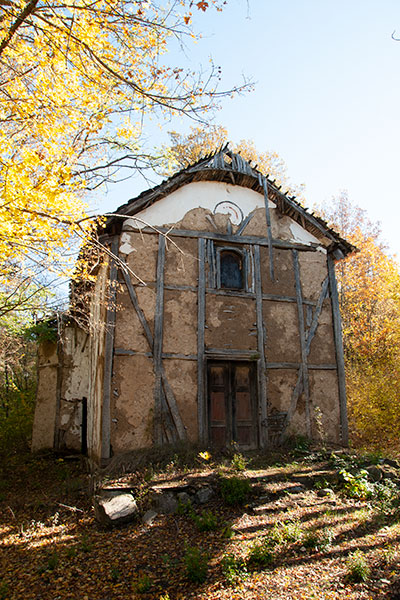
The consecration took place in May 1896, as evidenced by the inscription on the stone cross located northeast of the altar partition. It is believed that the church was built on the site of an older sacral building, on which a covenant cross dedicated to the Holy Archangel Michael was erected in 1842. The church completely collapsed a few years ago.
On the opposite side of the entrance, there was a belfry of light wooden construction under a hipped roof covered with tiles. The bell was a gift from Rafajlo Prvulović, the president of the church municipality, and his wife in 1935. It was made in the bell foundry of engineer P. Jovanović in Novi Sad.
Due to the dilapidation of the supporting structure, the bell fell from the belfry, and soon after it was transferred to the premises of the Knjaževac church municipality.
On the northwest side of the church, there are several priests’ graves, among them the grave of priest Ignjat Popović, as well as the graves of their family members.
Gallery


Architecture
The church was located on a raised plateau near the old village school and the local office. It was built in the “bondruk” technique, with a combination of wooden structural beams, mesh and mud, plastered and painted white.
The foundation of the church was in the form of a trikonchos with a spacious apse on the east of two smaller side conches – the choir. The wide and spacious nave of the church was vaulted with a semi-shaped vault. The temple collapsed due to the lack of maintenance of the roof, which led to the gradual and eventually complete deterioration of the altar and choir space, and a little later to the complete collapse of the roof structure and walls.
On the western facade, above the simple door, there was a rectangular niche with an icon of the patron saint of the temple on sheet metal. Above it, fragments of a circular, colored field imitating a circular window opening – a rosette – could be discerned. The church had one window opening on the side walls of the nave as well as on the naves. According to the red and dark colored traces, it could be concluded that the church had colored decorative strips that followed the architectural structure and openings of the church. There was another entrance to the church on the north side. Considering the time of creation and construction technique, it can be said that this was a very spacious and large church. The foundations of the church were 13 meters long and 5.4 meters wide.


The iconostasis was very simple, made of wood and made of wide gray marbled boards. Most likely, the rest of the furniture was ordered from the same workshop at the same time as the iconostasis, because they are decorated in the same way. On the iconostasis, until the collapse of the church, there were only a few preserved icons on sheet metal, and they were all gifts from individuals. It is believed to have been made at the beginning of the 20th century.
In the lowest zone, there was an icon of Saint Nicholas (framed serigraphy), a contribution of the brothers Božin and Sava A. Branković from 1931, as well as a framed icon of the Holy Great Martyr George on tin. On the Royal door, there was an image of the Annunciation, a gift from the family of Raka Nikolić from 1908. Above the place where the enthroned icon of the Virgin was supposed to stand, there was a small icon of the Baptism of Christ, and on the opposite side of the Transfiguration, the contribution of Dimitrij Prvulović from 1910.
In the highest zone, the central position was occupied by the icon of the Holy Trinity, above which was the Crucifixion with representations of the Virgin and Saint John the Theologian.


Based on the traces of the reddish-colored layer, it could be concluded that the church was brightly painted in the thirties of the 20th century. On the north and south sides of the church, there were two fresco icons, up-to-waist representations of Saint Pantaleon and Saint Paraskeva, done in fresco technique.