Church of the Nativity of the Holy Mother of God
Location: Gabrovnica
Year of construction: 19th century
The Church of the Nativity of the Holy Mother of God is located on the site of a former uranium mine, at the entrance to the village of Gabrovnica. It is considered to have been built in the Middle Ages based on the inscription “Pod.
Torma 1395” on the covenant cross that was once located in this place. The building was renovated in the second half of the 19th century.
On the southern wall of the western facade, next to the entrance door to the church, there is an inscription carved in tufa, and next to it is a stone monument with an engraved inscription.
South-east of the altar apse is a stone tombstone from 1889. North of the church is the belfry, the lower part of which is built in post and petrail, while the upper part is made of a light, wooden construction that carries the bells. Next to the bell tower was the parish house, now in ruins.
To the east of the church is the village cemetery. The surroundings of the church are filled with tailings from the former mine.
The church was restored in 2016 with the efforts of the donor Tomislav Ćirić and the inhabitants of the village of Gabrovnica, the board of the local community and the craftsmen who carried out the work, as evidenced by the inscription carved into the black marble slab.
Gallery


Architecture
The church is in its base a one-nave building, built of local stone – tufa and brick, plastered and painted white. The interior of the church consists of a nave and an altar area in the east.
The church is vaulted with a semi-circular vault, while the two-pitched roof of the church is covered with tiles. The shallow altar apse vaulted with a semi-dome, semi-circular on the outside and inside, is covered with stone slabs.
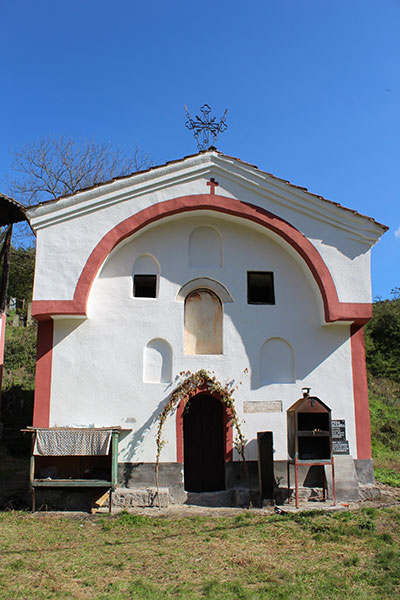
The western facade is dominated by a massive blind arch that extends under the roof of the church, and which completely covers it. In the lunette above the entrance door, there is a very damaged representation of the Nativity of the Holy Mother of God, made in fresco technique.
Previously, on some damaged parts, traces of decorative, dark blue-colored bands were recognizable, which were covered and replaced by church-colored bands during the renovation in 2016. On both sides of the lunette, there are two square window openings as well as several shallow, arched niches. In the zone under the roof, along the facade of the southern wall, there is a series of shallow arched niches.
On the northwest side of the church facade, under the roof, there is another shallow arched niche with a much-damaged fresco icon of an unknown saint. On the northeast side of the church, there is an entrance of smaller dimensions.


The altar partition of smaller dimensions is made of wood. It is the work of fresco painters Pavle Stojanović and Vasil Krstić from Debar, and it was created in 1860, as evidenced by the inscription on the iconostasis. The rich painted decoration of the constructive elements of the iconostasis was done in bright colors using the egg tempera technique. On the iconostasis, in addition to the royal door, there is only a northern side door.
Although small in size, the iconostasis can be divided into three zones. In the lower zone, scenes from the Garden of Eden, the creation of Eve and the Original Sin are presented. This lower zone also includes the royal doors, which are divided into three fields. In the lowest field are shown in pairs: Saint Athanasius and Saint John Chrysostom, Saint Basil the Great and Saint Gregory the Theologian.
In the central field of the imperial doors is a representation of the Annunciation, and in the highest zone the Old Testament emperors David and Solomon. In the zone of throne icons, on the north door, there is a half-length representation of the Holy Archangel Michael. Next to it is the icon of the Virgin with Christ, followed by representations of Jesus Christ, Saint John the Baptist and Saint Nicholas.
The upper zone includes the apostolic order with twelve icons of the apostles and the central icon of Jesus Christ. In the highest zone is the Crucifixion, surrounded by the instruments of Christ’s suffering. Below it is Adam’s skull, around which are dragons, and behind them representations of the Moon and the Sun.
There are no visible traces of fresco painting in the church, except in a niche on the north wall of the altar space where a cross with a cryptogram is represented. Considering the preserved traces of decorative wall painting on the facade of the church, the remains of fresco icons in the niches, as well as the reddish-colored area of the plinth in the interior of the church, it is possible to conclude that in the church was once there were frescoes.